




How Belen Businesses Can Build a Simple Forklift Maintenance Calendar
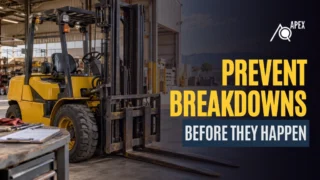
Many Belen businesses only learn about a small forklift problem when a machine stops in the middle of a shift. A forklift maintenance calendar is a one page schedule that lists what to check on each machine, how often, and who is responsible, so repairs happen on your terms instead of after a breakdown.
What Should a Forklift Maintenance Calendar Include?
Four things: a list of every machine you run, a note on how hard each one works, three layers of checks (daily, monthly, and seasonal), and a simple log of what was found. Everything else is extra.
The maker’s manual tells you what each machine needs. The calendar tells you when you will actually look at it. Without the calendar, even a business that knows what to do tends to put it off until something breaks.
Why Is a Calendar Better Than Fixing Things When They Break?
Because forklift trouble rarely shows up all at once. A hose starts to seep, a battery holds a little less charge each week, and a tire slowly loses pressure. Each one is easy to miss on a busy day and cheap to fix early.
A calendar catches these small signs on a regular schedule. It also makes costs easier to plan, since a booked visit is a known cost, while a breakdown in the middle of a shift is a surprise.
How Do You Start Building One?
Start by listing every machine you run. For each one, write down the make, model, year, serial number if you have it, and the type of power, such as electric, gas, LPG, or diesel. Add where it works most of the time and whether it is used lightly, steadily, or heavily.
Do not forget the machines that are not forklifts. Telehandlers, boom lifts, and skid steers belong on the same list, since they break down for the same reasons and stop the same work.
How Often Should Each Machine Be Checked?
It depends on how hard the machine works, not just how old it is. Two forklifts of the same age can need very different care. One that runs a full shift every day wears out faster than one that moves a few pallets a week.
This is the idea most calendars miss. Do not give every machine the same schedule. Give your hardest working machine the closest attention, and keep a lighter schedule for the one that sits most days. The manual sets what is due, and your use sets how closely you watch.
What Are the Three Layers of Checks?
Daily, monthly, and seasonal. Each layer has a different person and a different job.
Daily checks belong to the operator. Before each shift, walk around the machine and look at the tires, forks, lights, and horn. Look under it for new drips, and notice how the brakes and steering feel. If anything seems off, tell someone before using it.
Monthly checks belong to whoever looks after the fleet. Look at fluid levels, hoses, battery condition, and cables. Compare machines to each other, since a machine that acts differently from its twin is worth a closer look.
Seasonal checks are done with a technician. Book a visit before your busy season, before cold weather, and before the hottest part of summer. This is where batteries, cooling systems, hydraulics, and brakes get a proper look from someone trained to find the real cause of a problem.
What Does a Full Year Look Like?
Here is a starting point you can change to fit your own busy season. Every day, the operator does a short walk around and reports anything new right away. Every month, someone checks fluids, hoses, tires, and batteries, reviews the notes from the past month, and passes any open problem to the technician.
Before your busiest weeks, book a technician visit at least a few weeks ahead and fix whatever is on the open list. Before cold weather, have batteries, charging systems, coolant, brakes, and lights tested. Before hot weather, have cooling systems and hydraulic hoses checked and filters cleaned or replaced as needed. Once a year, give every machine a full safety inspection and update your machine list.
When Should Checks Happen in Central New Mexico?
Just ahead of the seasons that push equipment the hardest. Summers here run hot and dry, with dust that gets into filters and connections. Winter mornings can be cold enough to make batteries and hydraulic fluid act sluggish. Put your seasonal checks before both, not in the middle of them.
If your business has a busy stretch, such as a construction push or a holiday rush, line your technician visit up before it starts. A machine that gets checked the week before a heavy workload is far less likely to fail in the middle of it.
What Should You Write Down?
Six things: the date, the machine, what was checked, what was found, who did the work, and when it is due next. A notebook or a shared spreadsheet is enough.
The log gives you something no manual can, a record of your own machines. After a few months, you will see which ones have the same problem again and again. When the same issue shows up twice, do not just replace the part again. Ask for the real cause to be found first, since a repeat problem usually means the first repair treated a symptom.
What Mistakes Should You Avoid?
The most common ones are using one schedule for every machine, having no single person in charge, doing the checks but not writing anything down, and skipping the oldest machine because it has always run fine. Another is waiting for the due date to book a technician, when the schedule has already filled up.
Common Questions About Forklift Maintenance Schedules
How often should a forklift be serviced? It depends on the maker’s schedule and how hard the machine works. The manual is the best starting point, and a technician can help you adjust the timing for heavy use.
Can maintenance be done at my location? In most cases, yes. A mobile technician can check and service equipment on site, so the machine does not have to be moved.
Who should own the calendar? One person. When several people share it, nobody checks it. Pick someone, and make sure they know it is their job.
Do electric and gas forklifts need different calendars? They share many checks, like tires, brakes, and lights. Electric machines add battery and charger checks, and engine machines add fuel, oil, and exhaust checks.
What if I only have one forklift? A calendar matters even more. When your only machine goes down, the work stops completely.
The Habit That Keeps It Working
The best calendar is the one people actually see. Print it, post it near the machines, and set a short review once every three months. A calendar that lives in a drawer gets forgotten, and one that hangs on the wall gets used.
Put Your Forklift Schedule on Paper Before the Next Breakdown
A plan you write today costs far less than a stopped shift next month. Apex Forklift Solutions offers preventive maintenance programs and on site safety inspections for forklifts and heavy equipment across Belen, Albuquerque, Rio Rancho, and Central New Mexico. Reach out today and get a maintenance schedule built around the way your equipment really works.